Дедов И.И., Петеркова В.А. Руководство по детской эндокринологии. Москва: Универсум Паблишинг, 2006. 600 p.
Charmandari E., Nicolaides N.C., Chrousos G.P. Adrenal insufficiency // The Lancet. 2014. Vol. 383, № 9935. P. 2152–2167.
Kirkgoz T., Guran T. Primary adrenal insufficiency in children: Diagnosis and management // Best Pract. Res. Clin. Endocrinol. Metab. 2018. Vol. 32, № 4. P. 397–424.
Park J., Didi M., Blair J. The diagnosis and treatment of adrenal insufficiency during childhood and adolescence // Arch. Dis. Child. 2016. Vol. 101, № 9. P. 860–865.
Ventura M. et al. The spectrum of pediatric adrenal insufficiency: insights from 34 years of experience // J. Pediatr. Endocrinol. Metab. 2019. Vol. 32, № 7. P. 721–726.
Oelkers W. Adrenal Insufficiency // N. Engl. J. Med. 1996. Vol. 335, № 16. P. 1206–1212.
Oelkers W., Diederich S., Bähr V. Diagnosis and therapy surveillance in Addison’s disease: rapid adrenocorticotropin (ACTH) test and measurement of plasma ACTH, renin activity, and aldosterone. // J. Clin. Endocrinol. Metab. 1992. Vol. 75, № 1. P. 259–264.
Jones D.A., Miras A., Tringham J.R. Addison’s disease: a diagnostic challenge // Br. J. Hosp. Med. 2008. Vol. 69, № Sup12. P. 192–195.
Bleicken B. et al. Delayed Diagnosis of Adrenal Insufficiency Is Common: A Cross-Sectional Study in 216 Patients // Am. J. Med. Sci. 2010. Vol. 339, № 6. P. 525–531.
White P.C., Speiser P.W. Congenital Adrenal Hyperplasia due to 21-Hydroxylase Deficiency // Endocr. Rev. 2000. Vol. 21, № 3. P. 245–291.
Rushworth R.L., Torpy D.J., Falhammar H. Adrenal crises: perspectives and research directions // Endocrine. 2017. Vol. 55, № 2. P. 336–345.
Bornstein S.R. et al. Diagnosis and Treatment of Primary Adrenal Insufficiency: An Endocrine Society Clinical Practice Guideline // J. Clin. Endocrinol. Metab. 2016. Vol. 101, № 2. P. 364–389.
Chakera A.J., Vaidya B. Addison Disease in Adults: Diagnosis and Management // Am. J. Med. 2010. Vol. 123, № 5. P. 409–413.
Sarah L T., Jill J., Kelly J. S. Morning Cortisol Levels Affected by Sex and Pubertal Status in Children and Young Adults // J. Clin. Res. Pediatr. Endocrinol. 2013. Vol. 5, № 2. P. 85–89.
Kazlauskaite R., Maghnie M. Pitfalls in the Diagnosis of Central Adrenal Insufficiency in Children // Endocrine Development / ed. Loche S. et al. S. Karger AG, 2010. Vol. 17. P. 96–107.
Schmidt I.L. et al. Diagnosis of Adrenal Insufficiency: Evaluation of the Corticotropin-Releasing Hormone Test and Basal Serum Cortisol in Comparison to the Insulin Tolerance Test in Patients with Hypothalamic-Pituitary-Adrenal Disease // J. Clin. Endocrinol. Metab. 2003. Vol. 88, № 9. P. 4193–4198.
Betterle C. et al. The natural history of adrenal function in autoimmune patients with adrenal autoantibodies // J. Endocrinol. 1988. Vol. 117, № 3. P. 467–475.
El-Farhan N. et al. Method-specific serum cortisol responses to the adrenocorticotrophin test: comparison of gas chromatography-mass spectrometry and five automated immunoassays // Clin. Endocrinol. (Oxf.). 2013. Vol. 78, № 5. P. 673–680.
Nisticò D. et al. Pediatric Adrenal Insufficiency: Challenges and Solutions // Ther. Clin. Risk Manag. Informa UK Limited, 2022. Vol. Volume 18. P. 47–60.
Bowden S.A., Henry R. Pediatric Adrenal Insufficiency: Diagnosis, Management, and New Therapies // Int. J. Pediatr. Hindawi Limited, 2018. Vol. 2018. P. 1–8.
Pecori Giraldi F. et al. Assessment of ACTH assay variability: a multicenter study // Eur. J. Endocrinol. 2011. Vol. 164, № 4. P. 505–512.
Van Rijn J.L.M.L. et al. Evaluation of ACTH immunoradiometric assays // Clin. Biochem. 1996. Vol. 29, № 1. P. 93–95.
Baker P.R. et al. Haplotype Analysis Discriminates Genetic Risk for DR3-Associated Endocrine Autoimmunity and Helps Define Extreme Risk for Addison’s Disease // J. Clin. Endocrinol. Metab. 2010. Vol. 95, № 10. P. E263–E270.
Hägg E., Asplund K., Lithner F. Value of basal plasma cortisol assays in the assessment of pituitary-adrenal insufficiency // Clin. Endocrinol. (Oxf.). 1987. Vol. 26, № 2. P. 221–226.
Jenkins D. et al. Use of ACTH in the diagnosis of adrenal cortical insufficiency // Am. J. Med. 1955. Vol. 18, № 1. P. 3–14.
Oelkers W. et al. Dose-Response Relationships Between Plasma Adrenocorticotropin (ACTH), Cortisol, Aldosterone, and 18-Hydroxycorticosterone After Injection of ACTH-(1–39) or Human Corticotropin-Releasing Hormone in Man* // J. Clin. Endocrinol. Metab. 1988. Vol. 66, № 1. P. 181–186.
Lee M.K.V. et al. Cortisol: ACTH ratio to test for primary hypoadrenalism: a pilot study // Postgrad. Med. J. 2013. Vol. 89, № 1057. P. 617–620.
Klose M. et al. Factors Influencing the Adrenocorticotropin Test: Role of Contemporary Cortisol Assays, Body Composition, and Oral Contraceptive Agents // J. Clin. Endocrinol. Metab. 2007. Vol. 92, № 4. P. 1326–1333.
Magnotti M., Shimshi M. Diagnosing Adrenal Insufficiency: Which Test is Best—The 1-μG or the 250-μG Cosyntropin Stimulation Test? // Endocr. Pract. 2008. Vol. 14, № 2. P. 233–238.
May M.E., Carey R.M. Rapid adrenocorticotropic hormone test in practice. Retrospective review // Am. J. Med. 1985. Vol. 79, № 6. P. 679–684.
Oelkers W. The role of high- and low-dose corticotropin tests in the diagnosis of secondary adrenal insufficiency // Eur. J. Endocrinol. 1998. Vol. 139, № 6. P. 567–570.
Pura M. et al. The low-dose (1 μg) Cosyntropin Test (LDT) for Primary Adrenocortical Insufficiency: Defining the Normal Cortisol Response and Report on First Patients with Addison Disease Confirmed with LDT // Exp. Clin. Endocrinol. Diabetes. 2009. Vol. 118, № 03. P. 151–157.
Kazlauskaite R. et al. Corticotropin Tests for Hypothalamic-Pituitary- Adrenal Insufficiency: A Metaanalysis // J. Clin. Endocrinol. Metab. 2008. Vol. 93, № 11. P. 4245–4253.
Saenger P. et al. Progressive Adrenal Failure in Polyglandular Autoimmune Disease* // J. Clin. Endocrinol. Metab. 1982. Vol. 54, № 4. P. 863–868.
Coco G. et al. Estimated Risk for Developing Autoimmune Addison’s Disease in Patients with Adrenal Cortex Autoantibodies // J. Clin. Endocrinol. Metab. 2006. Vol. 91, № 5. P. 1637–1645.
De Bellis A. et al. Remission of subclinical adrenocortical failure in subjects with adrenal autoantibodies. // J. Clin. Endocrinol. Metab. 1993. Vol. 76, № 4. P. 1002–1007.
Bala N.M. et al. Autoimmune Primary Adrenal Insufficiency in Children // J. Clin. Res. Pediatr. Endocrinol. Galenos Yayinevi, 2022. Vol. 14, № 3. P. 308–312.
Esposito D., Pasquali D., Johannsson G. Primary Adrenal Insufficiency: Managing Mineralocorticoid Replacement Therapy // J. Clin. Endocrinol. Metab. 2018. Vol. 103, № 2. P. 376–387.
Conrad K. et al. Autoantibody diagnostics in clinical practice // Autoimmun. Rev. 2012. Vol. 11, № 3. P. 207–211.
Winqvist O., Karlsson F.A., Kämpe O. 21-hydroxylase, a major autoantigen in idiopathic Addison’s disease // The Lancet. 1992. Vol. 339, № 8809. P. 1559–1562.
Laureti S. et al. Etiological Diagnosis of Primary Adrenal Insufficiency Using an Original Flowchart of Immune and Biochemical Markers 1 // J. Clin. Endocrinol. Metab. 1998. Vol. 83, № 9. P. 3163–3168.
Speiser P.W. et al. Congenital Adrenal Hyperplasia Due to Steroid 21-Hydroxylase Deficiency: An Endocrine Society Clinical Practice Guideline // J. Clin. Endocrinol. Metab. 2010. Vol. 95, № 9. P. 4133–4160.
Bornstein S.R. Predisposing Factors for Adrenal Insufficiency // N. Engl. J. Med. 2009. Vol. 360, № 22. P. 2328–2339.
Vita J.A. et al. Clinical clues to the cause of Addison’s disease // Am. J. Med. 1985. Vol. 78, № 3. P. 461–466.
Horn M.A. et al. Screening for X-linked adrenoleukodystrophy among adult men with Addison’s disease // Clin. Endocrinol. (Oxf.). 2013. Vol. 79, № 3. P. 316–320.
Laureti S. et al. X-linked adrenoleukodystrophy is a frequent cause of idiopathic Addison’s disease in young adult male patients. // J. Clin. Endocrinol. Metab. 1996. Vol. 81, № 2. P. 470–474.
Nickelsen T., Schulz F., Demisch K. Studies on Cortisol Substitution Therapy in Patients with Adrenal Insufficiency // Exp. Clin. Endocrinol. Diabetes. 2009. Vol. 82, № 04. P. 35–41.
Czock D. et al. Pharmacokinetics and Pharmacodynamics of Systemically Administered Glucocorticoids: // Clin. Pharmacokinet. 2005. Vol. 44, № 1. P. 61–98.
Simon N. et al. Pharmacokinetic Evidence for Suboptimal Treatment of Adrenal Insufficiency with Currently Available Hydrocortisone Tablets: // Clin. Pharmacokinet. 2010. Vol. 49, № 7. P. 455–463.
Peacey S.R. et al. Glucocorticoid replacement therapy: are patients over treated and does it matter? // Clin. Endocrinol. (Oxf.). 1997. Vol. 46, № 3. P. 255–261.
Howlett T.A. An Assessment of Optimal Hydrocortisone Replacement Therapy // Clin. Endocrinol. (Oxf.). 1997. Vol. 46, № 3. P. 263–268.
Laureti S., Falorni A., Santeusanio F. Improvement of treatment of primary adrenal insufficiency by administration of cortisone acetate in three daily doses // J. Endocrinol. Invest. 2003. Vol. 26, № 11. P. 1071–1075.
Barbetta L. et al. Comparison of different regimens of glucocorticoid replacement therapy in patients with hypoadrenalism // J. Endocrinol. Invest. 2005. Vol. 28, № 9. P. 632–637.
Ekman B. et al. A randomized, double-blind, crossover study comparing two- and four-dose hydrocortisone regimen with regard to quality of life, cortisol and ACTH profiles in patients with primary adrenal insufficiency // Clin. Endocrinol. (Oxf.). 2012. Vol. 77, № 1. P. 18–25.
Forss M. et al. Current practice of glucocorticoid replacement therapy and patient-perceived health outcomes in adrenal insufficiency - a worldwide patient survey // BMC Endocr. Disord. 2012. Vol. 12, № 1. P. 8.
Bonfig W. et al. Hydrocortisone Dosing during Puberty in Patients with Classical Congenital Adrenal Hyperplasia: An Evidence-Based Recommendation // J. Clin. Endocrinol. Metab. 2009. Vol. 94, № 10. P. 3882–3888.
Grigorescu-Sido A. et al. Growth Analysis in Patients with 21-Hydroxylase Deficiency Influence of Glucocorticoid Dosage, Age at Diagnosis, Phenotype and Genotype on Growth and Height Outcome // Horm. Res. Paediatr. 2003. Vol. 60, № 2. P. 84–90.
Purnell J.Q. et al. Association of 24-Hour Cortisol Production Rates, Cortisol-Binding Globulin, and Plasma-Free Cortisol Levels with Body Composition, Leptin Levels, and Aging in Adult Men and Women // J. Clin. Endocrinol. Metab. 2004. Vol. 89, № 1. P. 281–287.
Plat L. et al. Metabolic Effects of Short-Term Elevations of Plasma Cortisol Are More Pronounced in the Evening Than in the Morning 1 // J. Clin. Endocrinol. Metab. 1999. Vol. 84, № 9. P. 3082–3092.
Fariss B.L. et al. Comparison of Absorption of Cortisone Acetate and Hydrocortisone Hemisuccinate* // J. Clin. Endocrinol. Metab. 1978. Vol. 47, № 5. P. 1137–1140.
Filipsson H. et al. The Impact of Glucocorticoid Replacement Regimens on Metabolic Outcome and Comorbidity in Hypopituitary Patients // J. Clin. Endocrinol. Metab. 2006. Vol. 91, № 10. P. 3954–3961.
Wiegand S. et al. Reduced 11β-hydroxysteroid dehydrogenase type 1 activity in obese boys // Eur. J. Endocrinol. 2007. Vol. 157, № 3. P. 319–324.
Williams G.H. et al. Studies of the control of plasma aldosterone concentration in normal man // J. Clin. Invest. 1972. Vol. 51, № 7. P. 1731–1742.
Fiad T.M. et al. The role of plasma renin activity in evaluating the adequacy of mineralocorticoid replacement in primary adrenal insufficiency // Clin. Endocrinol. (Oxf.). 1996. Vol. 45, № 5. P. 529–534.
Keilholz U., Guthrie G.P. Case Report: Adverse Effect of Phenytoin on Mineralocorticoid Replacement with Fludrocortisone in Adrenal Insufficiency // Am. J. Med. Sci. 1986. Vol. 291, № 4. P. 280–283.
Ross I.L. et al. Cardiovascular Risk Factors in Patients with Addison’s Disease: A Comparative Study of South African and Swedish Patients // PLoS ONE / ed. Stover C.M. 2014. Vol. 9, № 3. P. e90768.
Inder W.J., Meyer C., Hunt P.J. Management of hypertension and heart failure in patients with Addison’s disease // Clin. Endocrinol. (Oxf.). 2015. Vol. 82, № 6. P. 789–792.
Neumann U. et al. Treatment of congenital adrenal hyperplasia in children aged 0–3 years: a retrospective multicenter analysis of salt supplementation, glucocorticoid and mineralocorticoid medication, growth and blood pressure // Eur. J. Endocrinol. Oxford University Press (OUP), 2022. Vol. 186, № 5. P. 587–596.
Mullis P.E., Hindmarsh P.C., Brook C.G.D. Sodium chloride supplement at diagnosis and during infancy in children with salt-losing 21-hydroxylase deficiency // Eur. J. Pediatr. Springer Science and Business Media LLC, 1990. Vol. 150, № 1. P. 22–25.
Repping-Wuts H.J.W.J. et al. A glucocorticoid education group meeting: an effective strategy for improving self-management to prevent adrenal crisis // Eur. J. Endocrinol. 2013. Vol. 169, № 1. P. 17–22.
Harsch I.A. et al. Cortisone replacement therapy in endocrine disorders - quality of self-care // J. Eval. Clin. Pract. 2010.
Braatvedt G.D., Newrick P.G., Corrall R.J. Patients’ self administration of hydrocortisone. // BMJ. 1990. Vol. 301, № 6764. P. 1312–1312.
Fleming L.K., Rapp C.G., Sloane R. Caregiver Knowledge and Self-Confidence of Stress Dosing of Hydrocortisone in Children With Congenital Adrenal Hyperplasia // J. Pediatr. Nurs. 2011. Vol. 26, № 6. P. e55–e60.
Quinkler M. et al. A European Emergency Card for adrenal insufficiency can save lives // Eur. J. Intern. Med. 2015. Vol. 26, № 1. P. 75–76.
Miller B.S. et al. Emergency Management of Adrenal Insufficiency in Children: Advocating for Treatment Options in Outpatient and Field Settings // J. Investig. Med. SAGE Publications, 2020. Vol. 68, № 1. P. 16–25.
Bizzarri C. et al. Adrenal crisis in infants and young children with adrenal insufficiency: Management and prevention // Front. Endocrinol. Frontiers Media SA, 2023. Vol. 14.
White K., Arlt W. Adrenal crisis in treated Addison’s disease: a predictable but under-managed event // Eur. J. Endocrinol. 2010. Vol. 162, № 1. P. 115–120.
On Behalf of Endo ERN (MTG1) et al. Therapy options for adrenal insufficiency and recommendations for the management of adrenal crisis // Endocrine. Springer Science and Business Media LLC, 2021. Vol. 71, № 3. P. 586–594.
Woodcock T. et al. Guidelines for the management of glucocorticoids during the peri‐operative period for patients with adrenal insufficiency: Guidelines from the Association of Anaesthetists, the Royal College of Physicians and the Society for Endocrinology UK // Anaesthesia. Wiley, 2020. Vol. 75, № 5. P. 654–663.
Mushtaq T. et al. Emergency and perioperative management of adrenal insufficiency in children and young people: British Society for Paediatric Endocrinology and Diabetes consensus guidance // Arch. Dis. Child. BMJ, 2023. Vol. 108, № 11. P. 871–878.
Allolio B. EXTENSIVE EXPERTISE IN ENDOCRINOLOGY: Adrenal crisis // Eur. J. Endocrinol. 2015. Vol. 172, № 3. P. R115–R124.
Hahner S. et al. High Incidence of Adrenal Crisis in Educated Patients With Chronic Adrenal Insufficiency: A Prospective Study // J. Clin. Endocrinol. Metab. 2015. Vol. 100, № 2. P. 407–416.
Reisch N. et al. Frequency and causes of adrenal crises over lifetime in patients with 21-hydroxylase deficiency // Eur. J. Endocrinol. 2012. Vol. 167, № 1. P. 35–42.
Fonseca V. et al. Acute adrenal crisis precipitated by thyroxine. // BMJ. 1986. Vol. 292, № 6529. P. 1185–1186.
Erichsen M.M. et al. Normal overall mortality rate in Addison’s disease, but young patients are at risk of premature death // Eur. J. Endocrinol. 2009. Vol. 160, № 2. P. 233–237.
Husebye E.S., Pearce S.H., Krone N.P., Kampe O. Adrenal insufficiency // Lancet. 2021. Vol. 397, № 10274. P. 613–629. УДД 5 УУР С
Дедов И.И., Петеркова В.А.. Справочник детского эндокринолога// 3-е изд., испр. и доп. – Москва: Литтерра, 2020. – 496 стр.
Ovejero García M.T. et al. Primary adrenal insufficiency: case study in 5 tertiary hospitals // An. Pediatr. 2024. Vol. 101, № 5. P. 303–309.
Çamtosun E, Sangün Ö. Treatment and Prevention of Adrenal Crisis and Family Education. J Clin Res Pediatr Endocrinol. 2025 Jan 10;17(Suppl 1):80-92. doi: 10.4274/jcrpe.galenos.2024.2024-6-12-S.
Yokoyama K et al. Advances in multimodal imaging for adrenal gland disorders: integrating CT, MRI, and nuclear medicine. Jpn J Radiol. 2025 Jun;43(6):903-926. doi: 10.1007/s11604-025-01732-6.
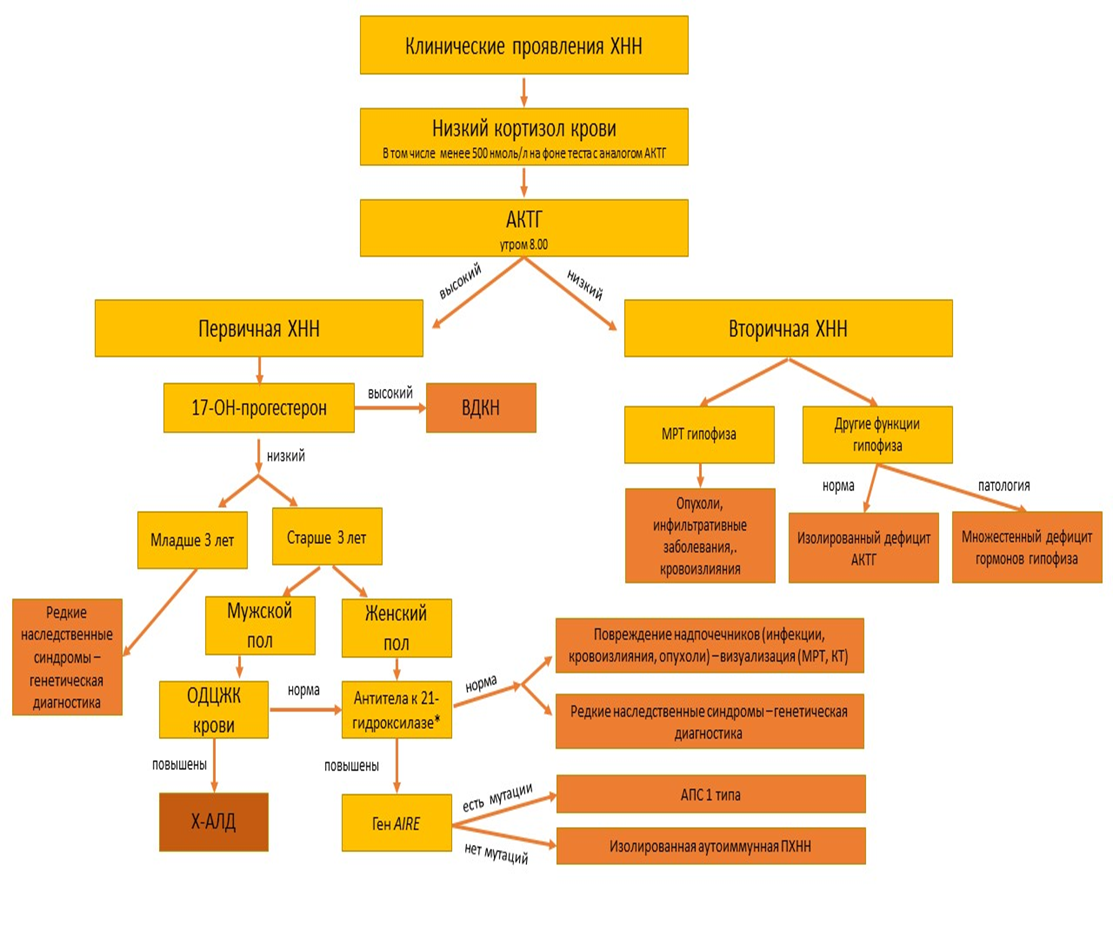 *при невозможности исследования антител к 21-гидроксилазе исключаем АПС 1 типа и далее переходим к исключению других наследственных синдромом и повреждения надпочечников.

